
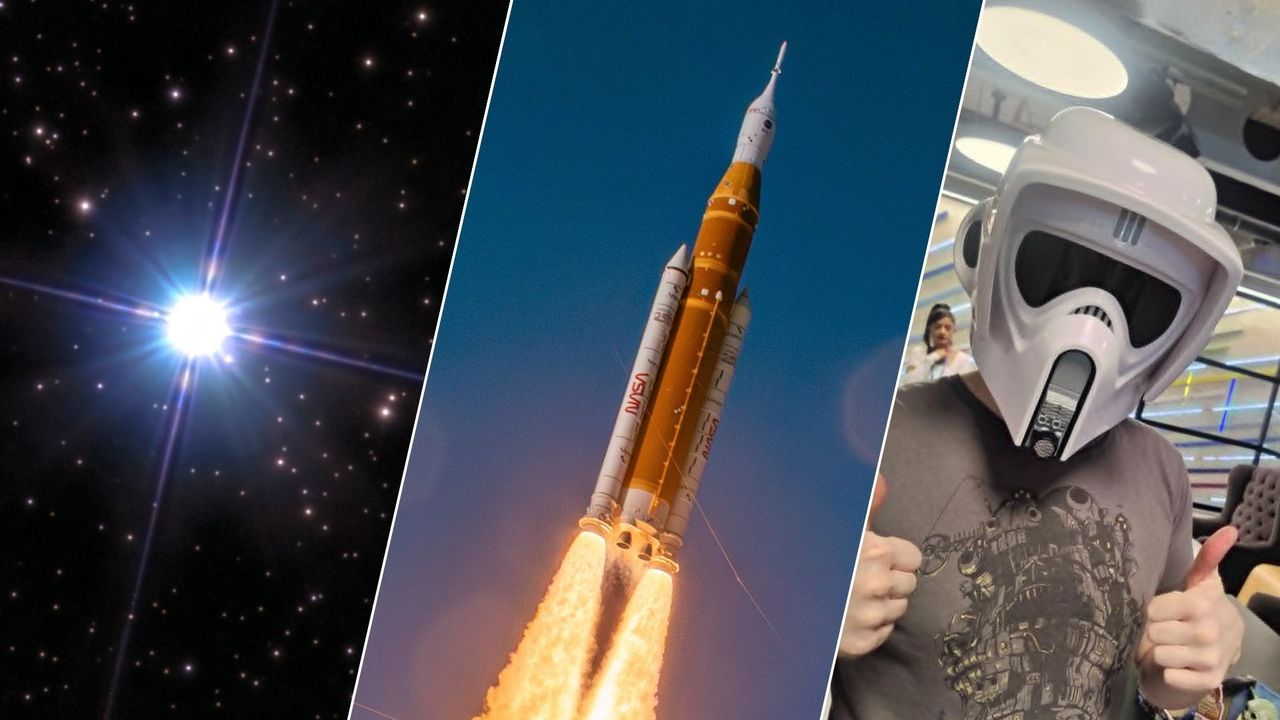
Galaxies, Artemis 2, space telescopes and stormtroopers: Here are the best photos from our staff
Photos from around the space team.
Complete Article Summary
Photos from around the space team.
Astronomical observations like these expand our knowledge of the universe and test our understanding of fundamental physics. Advanced telescopes and detection systems, operating across multiple wavelengths from radio to gamma rays, allow scientists to peer deeper into space and time than ever before.
Modern observatories combine cutting-edge optics, adaptive systems, and sophisticated data processing to reveal phenomena that were invisible to previous generations of instruments. From exoplanet atmospheres to the earliest galaxies formed after the Big Bang, these observations challenge and refine our cosmological models.
The data collected contributes to multiple fields of study, including stellar evolution, galactic dynamics, dark matter distribution, and the expansion rate of the universe. Each observation adds pieces to the grand puzzle of cosmic history and our place within it.
Related Articles

Solar radio bursts reveal hidden magnetic switchbacks near the sun, Parker Solar Probe data suggest
Solar radio bursts are intrinsically linked to the motion of their emitting source through the coronal and heliospheric plasma. Electron transport is mostly confined to magnetic field lines. These electrons move at a substantial fraction of the speed of light and often generate radio emission via the plasma emission process.
Canada proposes POET mission to hunt Earth-sized planets
Exoplanet science and the search for life beyond Earth continue to advance at break-neck speeds, with the number of confirmed exoplanets by NASA rapidly approaching 6,300, with 223 of those exoplanets being designated as terrestrial (rocky) exoplanets. With the promise of discovering an increasing number of Earth-sized exoplanets increasing every day, new telescopes from across the world have the opportunity to contribute to this incredible field.
NASA to increase value of CLPS contract to support surge of lunar lander missions
NASA is planning to increase the total value of a contract for robotic lunar lander missions to support a proposed surge in flights for the agency’s moon base plans. The post NASA to increase value of CLPS contract to support surge of lunar lander missions appeared first on SpaceNews.
More Space News
Related articles will be displayed here based on category and content similarity.